
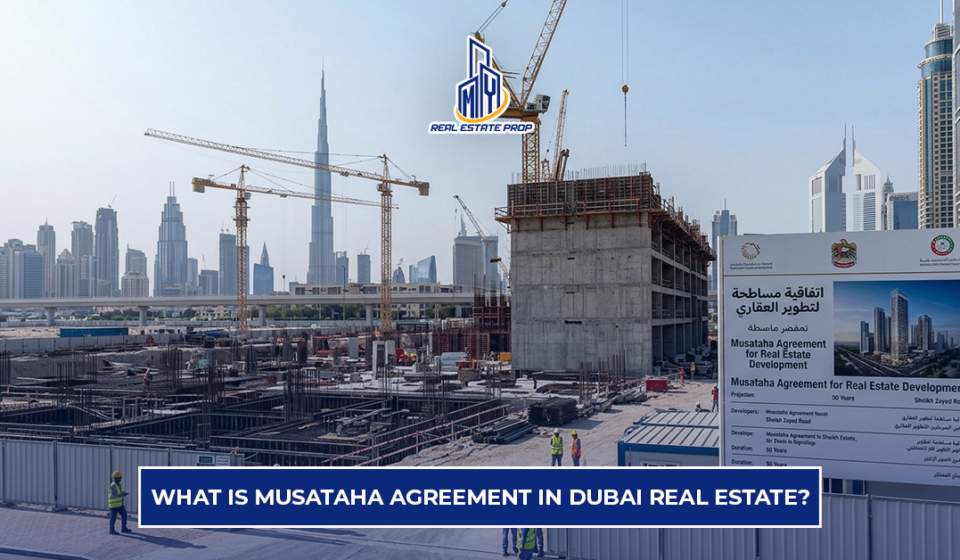
What Is Musataha Agreement in Dubai Real Estate?
Dubai’s real estate market offers multiple ownership and usage models, and one of the most strategic among them is the Musataha agreement Dubai structure. Highlighting its role can help investors feel more confident in its importance for large-scale projects, as it quietly powers commercial and industrial developments across the city.
A Musataha agreement enables a developer to use land owned by another party and build on it for a long period, functioning as a key tool for encouraging private investment in projects where land ownership remains centralised.
Understanding Musataha Agreement in Dubai
At its core, a Musataha agreement in Dubai is a long-term contractual arrangement between a landowner (Musatahee) and a developer. The developer receives the right to construct and use buildings on the land, while the land itself remains owned by the original party.
This model is built on the concept of surface rights in Dubai, which separates land ownership from construction ownership. The structure is governed and registered with authorities such as the Dubai Land Department, ensuring legal protection and transparency. Unlike traditional ownership, the Musataha contract in the UAE creates a controlled development environment where both parties benefit without transferring land title.
Legal Framework of Musataha Contract UAE
Duration and Structure
A Musataha agreement in Dubai typically runs for up to 50 years, with an option for renewal. This long duration provides enough time for developers to recover investment and generate returns. At the end of the agreement, the ownership of constructed assets may transfer to the landowner, or both parties may agree to extend the contract. It makes it similar to long-term lease agreements, but with significantly more flexibility for development.
Ownership Rights
Under a Musataha agreement, ownership is clear. The developer owns the buildings during the agreement period, while the landowner retains full ownership of the land.
The Musataha contract in the UAE also allows the developer to transfer or mortgage their rights, provided the necessary approvals are in place. It gives it a semi-ownership characteristic, which is standard in lease agreements.
Registration and Compliance
For a Musataha agreement in Dubai to be legally valid, it must be registered with the Dubai Land Department. The contract must define key elements, including duration, permitted use, financial terms, and exit conditions.
This formal registration ensures enforceability and protects both the investor’s and the landowner’s interests.
Musataha vs Freehold vs Leasehold
| Feature | Musataha Agreement Dubai | Freehold | Leasehold |
| Land Ownership | Retained by owner | Fully owned | Retained by owner |
| Building Ownership | Developer owns (temporary) | Fully owned | Limited |
| Duration | Up to 50 years | Permanent | Fixed term |
| Development Rights | Extensive | Full | Restricted |
The Musataha agreement Dubai, sits between ownership and leasing, offering development control without transferring land ownership.
Where Musataha Agreements Are Used
The Musataha agreement in Dubai is actively in sectors where large-scale development is required, but land ownership remains centralised. It includes industrial zones, logistics parks, and commercial hubs.
Dubai uses this structure to maintain long-term planning control while attracting private investment into infrastructure and business ecosystems.
Benefits of Musataha Agreement Dubai
The biggest advantage of a Musataha agreement is cost efficiency. Investors do not need to purchase land, which significantly lowers the initial capital requirement. It allows developers to focus their resources on construction and operations. Another key benefit lies in flexibility. The Musataha contract enables developers to design and build projects tailored to their business needs. It is especially valuable for industries that require customised infrastructure.
Long-term stability also plays a crucial role. With agreements extending up to 50 years, investors gain enough time to generate consistent returns. Compared to short-term leases, the Musataha agreement Dubai offers a more predictable investment horizon. Additionally, the ability to transfer or finance Musataha rights enhances its attractiveness. Investors can treat the agreement as a structured asset, making it viable for long-term planning.
Risks and Limitations
Despite its advantages, the Musataha agreement in Dubai has certain limitations that investors must carefully evaluate. The most important limitation is the absence of land ownership. Even after investing in construction, the land remains with the original owner. It affects long-term asset value compared to freehold properties.
Another concern is contract expiry. Once the agreement ends, ownership of the developed property may transfer to the landowner unless renewal terms are in place. It creates uncertainty, especially for projects with long ROI cycles.
Approval dependencies also exist. Any transfer, financing, or structural modification under a Musataha contract in the UAE usually requires the consent of the landowner and the relevant regulatory authorities. It reduces operational flexibility compared to outright ownership.
Market Behavior Pattern
| Phase | Market Condition | Impact on Musataha Agreement Dubai |
| Expansion | High demand and growth | Increase in Musataha developments |
| Peak | Rising land prices | Higher adoption of Musataha model |
| Correction | Market slowdown | Fewer new agreements |
| Recovery | Renewed investor confidence | Strong comeback of Musataha deals |
Impact of Global Conflicts
Global conflicts often create uncertainty in international markets, but Dubai tends to benefit due to its stable regulatory environment.
In the short term, new Musataha agreement Dubai deals may slow down as investors adopt a cautious approach. However, this phase is usually temporary.
As global instability increases, capital shifts toward secure markets. Dubai sees increased inflows, particularly in commercial and industrial sectors. This drives renewed demand for structures like the Musataha contract in the UAE, which offer flexibility without full ownership risk.
Recovery Pattern in Dubai Real Estate
Dubai’s real estate market follows a consistent recovery cycle. The Musataha agreement Dubai plays a supportive role in this process by enabling controlled and scalable development.
The cycle typically starts with a slowdown where investor sentiment weakens. It is by a gradual inflow of capital as global investors seek stability. Demand then increases, particularly in sectors supported by Musataha structures. Eventually, the market stabilizes and begins to grow again. Because the Musataha agreement in Dubai reduces upfront investment risk, it is used during recovery phases.
Role of Musataha in Dubai’s Growth
The Musataha contract in the UAE is an important tool in Dubai’s long-term urban and economic strategy. It allows the government and landowners to retain control over land while enabling private sector development.
This model supports infrastructure expansion, industrial growth, and business ecosystem development. It aligns with Dubai’s vision for sustainable, controlled real estate expansion.
Practical Example
Consider a logistics company entering Dubai. Instead of purchasing land, it signs a Musataha agreement with Dubai for 30 years. The company builds warehouses and operational facilities tailored to its needs.
During the agreement period, it fully utilises and benefits from the property. At the end of the term, the landowner may take ownership of the structures or extend the agreement.
This approach allows the company to operate efficiently without committing large capital to land acquisition.
Conclusion
The Musataha agreement in Dubai offers a strategic balance between ownership and leasing. It provides developers with long-term usage rights, development flexibility, and reduced capital requirements, while landowners retain control of their assets.Although it comes with limitations such as contract expiry and lack of land ownership, its role in Dubai’s real estate ecosystem remains significant. For investors looking to enter the market with a structured, flexible approach, the Musataha contract in the UAE stands out as a practical, scalable option.