

Dubai Real Estate Market Forecast 2026: What Experts Predict
The Dubai real estate market forecast 2026 reflects a transition phase. The market is no longer in the explosive growth cycle seen between 2022 and 2024. Instead, it is moving toward a more structured, data-driven environment where supply, pricing discipline, and investor behavior play a critical role.
If you look at official data from Dubai Land Department and insights from CBRE Group and Knight Frank, one thing becomes clear: 2026 is not about rapid gains. It is about sustainable growth backed by real demand.
Market Overview: Entering a Stabilization Cycle
The Dubai real estate market forecast 2026 indicates that the market is stabilizing after a strong multi-year rally. Property prices surged significantly from 2022 through 2024 due to high international demand, limited supply in prime areas, and favorable government policies.
In 2026, the pace of growth is expected to moderate. This does not signal a decline. It reflects a healthier market structure where price increases align more closely with actual demand and economic fundamentals. Developers are launching projects at a steady rate. Buyers are more selective. Investors are analyzing yield rather than chasing short-term appreciation. This shift marks the beginning of a mature cycle.
Demand Drivers: Why Dubai Remains Attractive
Dubai continues to attract strong global investor interest due to its tax-free environment, high-quality infrastructure, and residency incentives linked to property ownership. Investors from Europe, Asia, and other regions see Dubai as a stable and secure market for capital preservation.
At the same time, steady population growth driven by job creation in sectors like tourism, finance, and technology is increasing housing demand. Government transparency and regulatory clarity from authorities like Dubai Land Department further strengthen confidence. These factors collectively ensure that demand remains a core pillar in the Dubai real estate market forecast 2026.
Supply Pipeline: The Key Market Variable
Supply is one of the most critical factors shaping the Dubai real estate market forecast 2026. A large number of residential units are scheduled for delivery between 2026 and 2028, particularly in areas such as Dubai South, Jumeirah Village Circle, and Mohammed Bin Rashid City. This increase in supply is gradually balancing the market after years of demand-driven growth.
In some mid-market areas, it may lead to slower price appreciation or temporary stagnation. However, prime locations with limited inventory are expected to remain stable. The expanding supply pipeline also gives buyers more options and stronger negotiation power, marking a shift toward a more balanced market.
Price Trends: A Mixed Outlook
The Dubai property market in 2026 is no longer moving in a single direction. Instead, it shows a clear split between premium, mid-market, and emerging locations. After years of aggressive price growth, the market is now transitioning into a more balanced phase where performance depends heavily on location, supply levels, and buyer demand. This shift is a key highlight of the Dubai real estate market forecast 2026, as it reflects a more mature and stable investment environment:
- Segmented Market Behavior
The market is no longer moving in one direction. Prime areas like Palm Jumeirah and Downtown Dubai continue to show stability due to limited supply, while mid-market areas may face slower growth due to higher inventory levels. - Shift from Rapid Growth to Stability
Price increases in 2026 are expected to be gradual rather than aggressive. This reflects a healthier market cycle where growth aligns with actual demand instead of speculation. - Location-Driven Performance
Property performance now heavily depends on micro-location factors such as infrastructure, connectivity, and community development rather than overall market momentum. - Reduced Volatility Risk
Controlled price growth lowers the risk of sharp corrections, making the market more attractive for long-term investors seeking predictable returns.
Rental Market Outlook
The rental market in Dubai remains strong and resilient heading into 2026. A growing expatriate population continues to drive demand for rental properties across different segments. Rental yields in Dubai remain competitive compared to major global cities, making it attractive for income-focused investors. The Dubai real estate market forecast 2026 suggests that while supply increases, demand is likely to keep pace, supporting overall rental stability. Additionally, the rise of short-term rentals and holiday homes is adding another layer of opportunity, especially in tourist-heavy areas. This ensures that rental income continues to be a key advantage of investing in Dubai real estate.
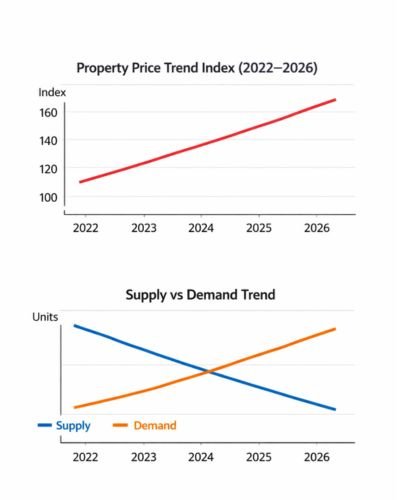
Graphical Market Trends (2022–2026)
Below is a simplified representation of market movement based on aggregated industry data:
Impact of Geopolitical Tensions and War
Short-Term Market Reaction: Geopolitical tensions, including conflicts in the Middle East and surrounding regions, can influence investor sentiment. During periods of uncertainty, some investors delay decisions.Transaction volumes may slow temporarily. However, Dubai often acts as a safe haven during global instability.
Capital Inflow During Crisis: Historically, Dubai has benefited from geopolitical uncertainty. Investors move capital into stable regions with strong governance. The Dubai real estate market forecast 2026 indicates that capital inflow may actually increase during prolonged instability.
This resilience comes from diversified economic sectors and proactive government policies.
Investment Opportunities in 2026
The Dubai real estate market forecast 2026 highlights a shift toward strategy-based investing rather than opportunistic buying. Investors are no longer relying on quick flips. Instead, they are focusing on long-term value, rental income, and future growth potential. This creates a more disciplined market where informed decisions lead to stronger returns.
- Emerging Areas with Infrastructure Growth
Locations with upcoming transport links, commercial hubs, and community developments offer strong upside potential. These areas provide lower entry prices and future appreciation opportunities. - Ready Properties for Immediate Cash Flow
Investors looking for stable income can benefit from ready units that generate rental returns from day one, especially in high-demand residential zones. - Off-Plan Projects with Flexible Payment Plans
Developers are offering attractive payment structures, making off-plan properties appealing for investors with long-term horizons and lower upfront capital. - Yield-Focused Investment Strategy
Instead of relying on capital appreciation alone, investors are now prioritizing rental yield, occupancy rates, and tenant demand to maximize returns. - Strategic Long-Term Positioning
The market rewards investors who focus on fundamentals such as developer credibility, project quality, and location sustainability rather than short-term speculation.
Key Risks to Consider
While the Dubai real estate market forecast 2026 remains positive overall, investors should stay aware of certain risks that can impact returns and decision-making.
- Oversupply in Certain Areas
High-volume project deliveries in locations like JVC and Dubai South may create temporary pressure on prices and rental yields, especially in mid-market segments. - Interest Rate Environment
Elevated global interest rates can reduce borrowing capacity, making mortgages more expensive and slowing down buyer activity. - Market Maturity and Buyer Selectivity
As the market matures, buyers are becoming more informed and selective. This increases competition among sellers and developers, especially for average-quality projects. - Developer Delivery Delays (NEW)
Delays in off-plan project completion can impact investor timelines, rental income expectations, and overall ROI. Investors must evaluate developer track records carefully. - Service Charges and Holding Costs (NEW)
High service charges in certain communities can reduce net rental yields. Investors often overlook these costs, but they directly impact long-term profitability.
Expert Insight: What 2026 Really Means
The Dubai real estate market forecast 2026 does not indicate a downturn. It signals evolution. The market is shifting from:
- Speculative growth → Strategic investment
- Rapid appreciation → Sustainable returns
- Broad demand → Targeted demand
This change benefits serious investors who understand market fundamentals.
Final Conclusion
The Dubai real estate market forecast 2026 presents a balanced and opportunity-driven landscape. Growth continues, but it is measured and selective.Dubai remains one of the most attractive real estate markets globally due to strong demand, investor-friendly policies, and economic stability. However, success in 2026 depends on strategy. Location, timing, and property type matter more than ever. If you approach the market with data, patience, and a clear investment goal, 2026 can still deliver strong returns.
The Dubai real estate market in 2026 isn’t about timing the market, it’s about understanding it. The better your strategy, the stronger your returns.